

There’s something oddly satisfying about the moment a car sounds exactly the way it should. Not loud for the sake of being loud, not obnoxious, just… right. A deeper growl, a sharper response, maybe even that subtle crackle on deceleration. For enthusiasts, that moment often begins with one upgrade: the exhaust system. And more specifically, the downpipe.
If you’ve been around performance cars long enough, you’ll know that not all upgrades are created equal. Some look good on paper but don’t quite translate to real-world gains. Others, like a well-designed downpipe system, quietly transform the driving experience in ways that feel both immediate and lasting.
Why Downpipes Matter More Than You Think
At its core, a downpipe is a pretty simple piece of engineering. It connects the turbocharger to the rest of the exhaust system. But simplicity can be deceptive. This component plays a huge role in how efficiently exhaust gases exit the engine, and that directly impacts power, throttle response, and even fuel efficiency.
Factory downpipes are usually built with restrictions in mind—emissions regulations, noise limits, and cost constraints. They do their job, but they’re not exactly designed for performance. Swap them out for a high-flow alternative, and suddenly the engine breathes easier. You feel it when you accelerate, and sometimes even when you’re just cruising.
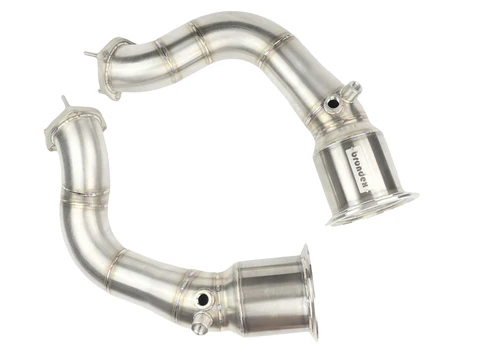
Take, for instance, setups like audi rsq8 sq7 downpipes. These aren’t just about adding horsepower on paper; they reshape how the car behaves under pressure. The turbos spool quicker, the lag feels reduced, and there’s a certain urgency that wasn’t there before. It’s the kind of change that doesn’t need explaining once you’ve experienced it.
The Subtle Art of Sound Tuning
Sound is subjective, no doubt about that. What one driver loves, another might find excessive. But there’s a difference between noise and tone. A good downpipe upgrade doesn’t just make your car louder—it refines the sound.
You might notice a deeper note at idle, a more aggressive growl under load, and a smoother transition between gears. It’s not about turning your car into a track monster (unless that’s your goal). It’s about giving it a voice that matches its potential.
Interestingly, many drivers say the biggest difference isn’t even the volume—it’s the clarity. The engine sounds less strained, more confident. Like it’s finally working without unnecessary resistance.
Performance Gains You Can Actually Feel
Let’s talk numbers for a second, but not in a dry, spec-sheet kind of way. Yes, aftermarket downpipes can add horsepower. Depending on the vehicle and setup, gains can range from modest to impressive. But what matters more is how those gains show up.
You press the accelerator, and the car responds quicker. Overtaking feels easier. The engine doesn’t feel like it’s holding back anymore. It’s subtle at first, then suddenly obvious.
For high-performance platforms, like BMW’s latest generation M models, a complete downpipe system for bmw m5 g90 / g99 touring can unlock a surprising amount of hidden potential. These cars are already engineered to a high standard, but they’re still bound by factory limitations. Freeing up the exhaust flow allows the engine to operate closer to its true capability.
And that’s where things get interesting—because it’s not just about speed. It’s about how the car feels in everyday driving. Smoother acceleration, better mid-range pull, even a slightly more engaging driving rhythm.
Installation: Not as Simple as It Sounds
Now, here’s the part people sometimes underestimate. Installing a downpipe isn’t always a plug-and-play experience. Depending on the vehicle, it can be a bit tricky. Tight spaces, complex routing, and the need for proper alignment all come into play.
That’s why it’s often worth having a professional handle the installation, especially if you’re dealing with a high-end performance car. A poorly installed downpipe can lead to leaks, vibrations, or worse—damage to surrounding components.
And then there’s the software side of things. Many modern vehicles require ECU tuning to fully benefit from the upgrade. Without it, you might not see the full performance gains, and in some cases, you could even trigger warning lights.
Balancing Performance with Practicality
It’s easy to get carried away when modifying a car. More power, louder sound, sharper response—it all sounds great. But there’s always a balance to strike.
For daily drivers, you’ll want to consider how the upgrade affects comfort and usability. Will the sound be too aggressive for long drives? Will it attract unwanted attention? These are small questions, but they matter over time.
The good news is that many modern downpipe systems are designed with this balance in mind. They offer improved performance without sacrificing drivability. It’s not about turning your car into something it’s not—it’s about enhancing what’s already there.
Final Thoughts: More Than Just an Upgrade
In the end, upgrading your downpipe isn’t just a technical decision—it’s a personal one. It’s about how you want your car to feel, sound, and respond. It’s about taking something that’s already impressive and making it uniquely yours.
And maybe that’s the real appeal. Not the horsepower figures or the decibel levels, but the connection. The sense that your car isn’t just a machine, but an extension of your preferences, your style, your way of driving.
Because once you’ve experienced that difference—the smoother pull, the richer sound, the sharper response—it’s hard to go back.