

Electric trucks and vans are no longer a future experiment. Fleets are buying them. Governments are mandating them. And fleet managers are discovering, sometimes the hard way, that running electric vehicles requires a completely different operational playbook than diesel.
The vehicles themselves work fine. The challenges are everything around them.
The battery is the most expensive part, and you can’t see inside it
With a diesel engine, experienced mechanics can listen, look, and diagnose. Batteries don’t work that way. Degradation happens quietly over months and years, influenced by charging habits, ambient temperatures, depth of discharge, and duty cycles. By the time range loss becomes noticeable to a driver, the damage is already done.
This is the core anxiety of EV fleet management, and it’s not about range in the way people usually mean. It’s about not knowing the true condition of your most expensive component until it’s too late to do anything cheap about it.
Battery replacements on commercial EVs can run anywhere from $10,000 to $30,000 depending on the vehicle. A fleet running 50 electric vans with poor charging practices could be looking at premature replacements across a significant portion of its assets. That’s a financial hit most operators haven’t budgeted for because the vehicles are supposed to be cheaper to maintain.
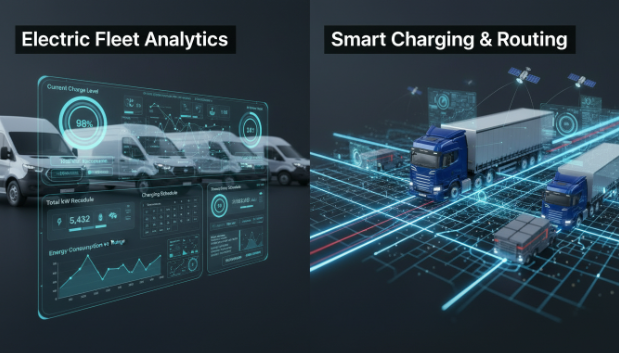
What’s starting to help is real-time EV monitoring that tracks battery health at the cell level, not just state of charge. Platforms that monitor charging cycles, thermal behavior, and capacity trends over time give fleet managers an early warning before degradation turns into an expensive surprise. Without that visibility, you’re flying blind on the single biggest line item in your EV cost structure.
Charging infrastructure is a logistics problem, not just an installation project
Most articles about EV charging talk about how many chargers you need. That’s the easy part. The hard part is everything that comes after installation.
Grid capacity is the first wall many fleets hit. A single DC fast charger can draw as much power as a small commercial building. Put ten of them at a depot and you’re looking at utility upgrades that take 18 to 36 months to plan and build. I’ve talked to operators who discovered this timeline after they’d already ordered the vehicles. Trucks arrive. Grid isn’t ready. Expensive assets sitting idle in a yard.
Then there’s load management. Charging 30 vehicles overnight sounds simple until you realize you can’t charge them all at once without tripping demand charges that destroy your electricity budget. Smart charging scheduling, where vehicles charge in staggered windows during off-peak hours, can cut electricity costs by 10-20%. But it requires software that understands both the grid constraints and the fleet’s operational schedule for the next morning.
Fleets that engage their utility company early, ideally 18 months before the vehicles show up, tend to avoid the worst bottlenecks. Those who treat charging infrastructure as an afterthought usually pay for it, literally.
Range prediction is still unreliable, and that creates scheduling chaos
Onboard range estimates on commercial EVs are notoriously inconsistent. The number on the dashboard might say 180 miles, but the actual range depends on load weight, road grade, weather, HVAC use, and how aggressively the driver accelerates. Two identical trucks on the same route can return with wildly different charge levels.
For a delivery fleet running tight schedules, this unpredictability is a real problem. If a driver comes back with 8% charge instead of the expected 25%, the next route assignment has to change. Multiply that uncertainty across a fleet and dispatchers spend half their day reworking plans.
Better range prediction, the kind powered by predictive maintenance and analytics platforms, uses motor torque, wheel speed, weather data, and historical route performance to give distance-to-empty estimates that actually hold up. That’s a different thing entirely from the estimate your dashboard gives you, which is usually based on average consumption over the last few miles of driving.
Mechanics need different skills, and there aren’t enough of them
The technician shortage was already a crisis for diesel fleets. Electric vehicles make it worse. EV maintenance is simpler in some ways — no oil changes, no exhaust systems, fewer brake jobs thanks to regenerative braking. But the work that does need doing requires specialized training in high-voltage systems, battery diagnostics, and electric drivetrain components.
Most independent shops aren’t equipped for it. Many dealership service departments are still getting up to speed. Fleet operators who assumed they’d save on maintenance labor are finding that specialized EV technicians command higher wages, and there simply aren’t enough of them.
Some fleets are training their existing mechanics, which works but takes time. Others are relying more heavily on remote diagnostics and predictive monitoring to reduce the number of shop visits in the first place. If the platform can tell you that the battery cooling system is trending toward a problem three weeks out, you can schedule one efficient repair instead of dealing with a roadside failure that requires a specialized mobile tech you can’t find on short notice.
Mixed fleets are the reality, and managing them is messy
Very few commercial fleets are going 100% electric overnight. Most are running mixed fleets for years during the transition, which means managing two completely different maintenance workflows, two different fueling/charging systems, two different cost structures, and often two different software platforms.
This split creates blind spots. Your diesel maintenance data lives in one system. Your EV battery and charging data lives in another. Nobody has a complete picture of fleet health and total cost of ownership across all assets.
Platforms that handle both diesel and EV monitoring under one roof, like Intangles’ approach to real-time EV fleet monitoring, are addressing this gap. The idea is that a fleet manager shouldn’t need to switch between three dashboards to understand which vehicles need attention tomorrow. Whether the truck runs on diesel, CNG, or battery power, the health data should flow into the same decision-making layer.
The regulatory landscape keeps shifting under your feet
California’s Advanced Clean Trucks rule. EPA emissions standards. State-level ZEV mandates. CARB regulations that effectively force you to buy an electric vehicle just to get the diesel truck you actually need right now. The regulatory environment around fleet electrification changes frequently enough that what you planned six months ago might not match what’s required today.
Multi-state fleets have it worst. Different states have different timelines, different incentive programs, and different utility preparedness levels. A charging setup that works perfectly in your California depot might be completely impractical at your Texas facility because the local utility hasn’t started a make-ready program yet.
There’s no magic fix for regulatory uncertainty. But fleets that invest in flexible infrastructure and software systems, things they can adapt as rules change, tend to weather the shifts better than those who build rigid, single-purpose setups.
The transition is happening whether you’re ready or not
None of this should scare anyone off electric vehicles. But it should scare off complacency. The fleets struggling hardest right now are the ones that assumed EVs would just slot in where diesel trucks used to go. That’s not how this works.
The operators getting it right planned their infrastructure before the vehicles arrived, invested in monitoring that tells them what’s happening inside their batteries, and stopped managing by check engine lights. Electric fleet management is messier than the vendor presentations suggest. But the tools are catching up. Fast.